The 10-second answer: A traditional lender is a big bank or credit union that sells lots of money things — bank accounts, credit cards, car loans and mortgages. A monoline lender sells just one thing: mortgages. Because they only do one job, monolines often have lower rates and smaller penalties if you need to break your mortgage early. The catch? You usually can’t walk into one, and they don’t sell all the extras a bank does.
That’s the whole idea. Now let’s go slowly, step by step, so it all makes sense.
In this guide
First: what is a lender?
Houses cost a lot of money. Way more than most people have in their piggy bank. So when people buy a home, they borrow most of the money.
The company that lends you the money is called the lender.
The big loan you use to buy a home is called a mortgage. You pay it back a little bit at a time, every month, for many years. On top of what you borrowed, you also pay a little extra. That extra is called interest. It’s like a “thank you” fee for borrowing the money.
The interest rate tells you how big that “thank you” fee is. A lower rate means you pay less. Even a small difference in the rate can add up to thousands of dollars over the years.
In Canada, there are two main kinds of lenders most people pick from: traditional lenders and monoline lenders.
What is a traditional lender?
A traditional lender is the kind you already know. Think of the big banks you see on street corners and at the mall — RBC, TD, Scotiabank, BMO, CIBC and National Bank. Credit unions are traditional lenders too.
Think of a traditional lender like a giant supermarket. A supermarket sells everything: fruit, bread, toys, shampoo, even flowers. A bank is the same. It sells:
- Chequing and savings accounts (where you keep your money)
- Credit cards
- Car loans and personal loans
- Lines of credit (money you can borrow whenever you need it)
- Investments, like RRSPs and TFSAs
- And mortgages
Mortgages are just one aisle in a very big store.
Banks have branches — real buildings with people inside. You can walk in, sit down and talk to someone face to face.
Where does a bank get the money it lends you? Mostly from other people’s savings. When people keep money in their bank accounts, the bank can lend some of that money out as mortgages.
What is a monoline lender?
Let’s break the word apart:
- “Mono” means one.
- “Line” means a kind of business.
So a monoline lender is a company with one kind of business: mortgages. That’s all they do, all day long.
Think of a monoline lender like a shop that only sells ice cream. You can’t buy bread or shampoo there. But because ice cream is the only thing they make, they’re really good at it, and they can often sell it for less.
Some well-known monoline lenders in Canada are MCAP, First National and CMLS. Many Canadians have never heard of them, but these companies look after huge numbers of Canadian mortgages.
Here are three things that make monolines special:
- No branches. There’s no building to walk into. You deal with them by phone, email or online.
- You meet them through a mortgage broker. Most monolines don’t sell to you directly. A mortgage broker is like a helpful guide who knows all the shops in town and takes you to the best one for you. (That’s what we do at Balo Financial.)
- They get their money differently. A monoline doesn’t hold people’s savings. Instead, it gets its money from big investors and special government-backed programs. This is a big reason they can keep their costs low.
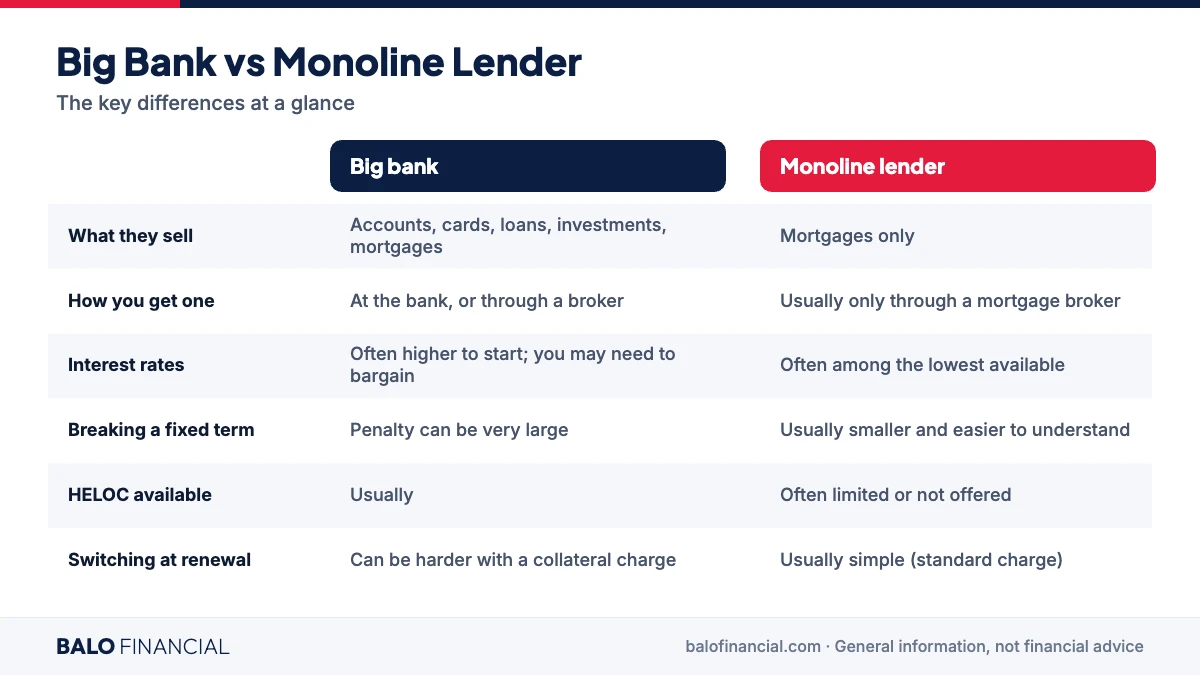
Side-by-side chart
| Question | Traditional lender (bank) | Monoline lender |
|---|---|---|
| What do they sell? | Lots of things — accounts, cards, loans, investments, mortgages | Only mortgages |
| Can I walk in? | Yes, they have branches | No — phone, email and online |
| How do I get one? | Go to the bank yourself, or through a broker | Usually only through a mortgage broker |
| Interest rates | Often higher to start; you may need to bargain | Often among the lowest available |
| Penalty to break a fixed mortgage early | Can be very large | Usually smaller and easier to understand |
| Home equity line of credit (HELOC) | Usually available | Often limited or not offered |
| Everything in one place? | Yes | No — your bank accounts stay at your bank |
| Switching lenders at renewal | Can be harder if they registered a “collateral charge” | Usually simple (standard charge) |
The 5 big differences (explained simply)
Difference #1: The price (your interest rate)
Monoline lenders often offer some of the lowest rates you can find. Why?
- No buildings to pay for. Branches cost a lot — rent, lights, staff. Monolines don’t have them, so they save money and can pass some of it to you.
- They only have one way to win you. A bank can make money from you in lots of ways — your credit card, your car loan, your savings. A monoline only earns money from your mortgage. So it has to give you a great deal to get your business.
- They compete in front of brokers every day. A broker can see many lenders’ rates side by side. Lenders that aren’t sharp lose the deal.
But not always. Sometimes a bank will offer a special rate, a cash-back deal, or match a lower rate to keep you. That’s why it pays to compare both.
Difference #2: The “breaking up” fee (prepayment penalty)
This is the biggest difference, and the one most people don’t know about.
When you sign a mortgage, you make a promise: “I’ll keep this mortgage for a set number of years.” That set time is called the term — often 5 years.
But life changes. You might sell your house, move to a new city, or want to borrow more. If you end the mortgage before the term is over, the lender charges you a fee. That fee is called a prepayment penalty. Think of it as a “breaking up early” fee.
With a variable-rate mortgage, the penalty is usually about 3 months of interest at both banks and monolines. Simple.
With a fixed-rate mortgage, the penalty is usually the bigger of two numbers: 3 months of interest, or something called the Interest Rate Differential (IRD). The IRD is the lender saying, “If you leave, we lose the interest you promised us, so you need to cover some of that.”
Here’s the key part. Banks and monolines often do the IRD math differently.
- Many big banks use their high “posted” rates (the advertised sticker price almost nobody actually pays) in the math. That can make the penalty much bigger.
- Many monolines use the rate you actually got. That usually makes the penalty smaller.
A simple example (rounded, for illustration only)
Sam owes $400,000 on a 5-year fixed mortgage at 5%. Sam has 3 years left and needs to sell the house.
- Monoline-style math: today’s 3-year rate is 4%. That’s 1% less than Sam’s rate. 1% × $400,000 × 3 years ≈ $12,000.
- Posted-rate (bank-style) math: when Sam signed, the bank’s posted rate was 6.5%, so Sam got a 1.5% discount. The bank’s posted 3-year rate today is 5%, minus that same 1.5% discount = 3.5%. That’s 1.5% less than Sam’s rate. 1.5% × $400,000 × 3 years ≈ $18,000.
Same house. Same mortgage size. About $6,000 more just because of how the penalty was calculated. Real penalties depend on each lender’s exact rules and can be higher or lower than this.
Why this matters: Lots of people think they’ll keep their mortgage for the full 5 years. But many people end up breaking it early — because of a new baby, a new job, a bigger house or a divorce. A smaller penalty is like a safety net.
Difference #3: What else they sell
Remember: a bank is a supermarket and a monoline is an ice cream shop.
If you like having everything in one place — your mortgage, your bank account and your credit card all in one app — a bank can do that. Some banks even give you a better deal if you bring them more of your business. This is called bundling.
The big one to know about is the HELOC (home equity line of credit). It lets you borrow against the part of your home you already own, whenever you need it — like a safety fund. Banks almost always offer these. Many monolines offer limited versions or none at all.
With a monoline, you simply keep your everyday banking at your regular bank. Your mortgage payment comes out of your bank account each month, just like any other bill. Most people never notice a difference.
Difference #4: How you talk to them
Bank: you can visit a branch, call, or use the app.
Monoline: no branch. You call, email or log in online. And at the start, your mortgage broker does most of the talking for you — gathering your papers, sending them in and getting you approved.
For most people today, this is no problem at all. But if you really like sitting across a desk from someone, a bank may feel more comfortable.
Difference #5: The rules (flexibility)
Every mortgage has rules about what you can and can’t do. Here are the ones to check, whichever lender you choose:
- Extra payments (prepayment privileges): how much extra you can pay each year without a penalty. Paying extra helps you finish your mortgage sooner.
- Porting: can you take your mortgage with you to a new house? Most lenders allow it, but the rules and time limits are different.
- Borrowing more mid-term: some banks make this easy by blending your old rate with a new one. Some monolines are stricter about this.
- Collateral charge vs. standard charge: this is how the mortgage is “locked” onto your home’s title. Some big banks use a collateral charge, which is like a lock that only their key opens — it can make it harder and more costly to switch lenders later. Monolines usually use a standard charge, which is easier to move to a new lender at renewal time.
The lesson: a mortgage is more than a rate. The rules matter too.
Are monoline lenders safe?
Yes. This is a very common worry, so let’s clear it up.
- You’re borrowing, not saving. You don’t keep your money with a monoline. They lend money to you. So there are no savings of yours at risk.
- They are big, established companies. The well-known monolines have been lending to Canadians for decades and look after mortgages worth many billions of dollars.
- Your deal is protected. Your mortgage is a signed contract. If a lender is ever sold or another company starts handling your payments, the terms you signed — your rate, your payment, your term — stay the same.
- Same qualifying rules. In most cases you still need to pass the same mortgage stress test you would at a bank. Insured mortgages (with less than 20% down) follow the same mortgage insurance rules either way.
Which one is right for you?
There’s no “always best” answer. It depends on you. Here’s a simple way to think about it.
A monoline might be a great fit if:
- You want one of the lowest rates you can get
- You might sell, move or refinance before your term ends (smaller penalty risk)
- You’re happy doing things by phone and online
- You want to be free to shop around easily at renewal
- You’re a first-time buyer with an insured mortgage (monolines are often very sharp here)
A traditional lender might be a better fit if:
- You want a HELOC or a combined mortgage-and-credit-line setup
- You like having all your banking in one place
- You want to walk into a branch and talk to someone
- Your bank is offering a strong bundled deal or cash back
- Your situation needs flexibility a monoline can’t offer
Quick memory trick: Bank = Big store, lots of things. Mono = One thing, often cheaper. Then ask: “Do I need the big store, or do I just need a great mortgage?”
And remember, there are other kinds of lenders too — like alternative (“B”) lenders and private lenders — for people whose income or credit doesn’t fit the usual boxes. Learn more on our private mortgages and self-employed mortgages pages.
Big words made small
- Lender: the company that lends you money.
- Mortgage: a big loan to buy a home, paid back over many years.
- Interest: the extra you pay for borrowing money.
- Interest rate: how big that extra is, shown as a percent (%).
- Term: how long you promise to keep your current mortgage deal (often 5 years).
- Amortization: how long it will take to pay off the whole mortgage (often 25 or 30 years).
- Fixed rate: your rate stays the same for the whole term.
- Variable rate: your rate can go up or down with the market.
- Prepayment penalty: the fee for ending your mortgage early.
- IRD (Interest Rate Differential): one way lenders calculate that fee on fixed mortgages.
- Posted rate: the lender’s advertised “sticker price” rate — usually higher than what people actually get.
- Mortgage broker: a licensed guide who compares many lenders for you and helps you get approved.
- HELOC: a line of credit that lets you borrow against your home’s value.
- Renewal: when your term ends and you sign a new deal for the next term.
Want more? See our full mortgage glossary.
Questions people ask
Is a monoline lender the same as a private lender?
No. Monoline lenders mostly lend to regular borrowers with good credit and steady income, often at very low rates. Private lenders are for special situations and usually charge much higher rates.
Why haven’t I heard of monoline lenders before?
Because they don’t have branches and don’t spend much on ads. They work mostly through mortgage brokers, so you usually only find them by working with one.
Can I go to a monoline lender directly?
Usually not. Most monolines only accept mortgages that come through a licensed mortgage broker.
Does a broker cost me money?
For most regular home mortgages, no. The lender usually pays the broker. (Special situations, like some private loans, can have fees — a good broker tells you up front.)
Can I switch from a bank to a monoline when my mortgage renews?
Often, yes. Renewal is the best time to switch, because there’s usually no penalty. If your bank used a collateral charge, there may be a few extra steps. Learn more about renewing your mortgage.
Will a monoline let me pay my mortgage off faster?
Most do. Many offer prepayment privileges like paying extra each year or increasing your regular payment. Check the exact limits before you sign.
Is my mortgage less safe with a monoline?
No. You signed a contract with set terms. Those terms stay the same for your term no matter who services the mortgage.
The bottom line
Banks are like big supermarkets: lots of products, branches you can walk into, and everything in one place. Monoline lenders are like a shop that only sells one thing: mortgages. They often have lower rates and friendlier penalties, but fewer extras.
The smartest move isn’t picking a side. It’s comparing both — and looking past the rate to the penalty, the rules and the flexibility.
Let us do the comparing for you
Balo Financial compares banks, monoline lenders and credit unions side by side — rates, penalties and fine print — so you get the right mortgage, not just the one closest to you. It’s free for most borrowers and there’s no obligation.
This article is general information, not financial or legal advice. Penalty examples are simplified and rounded for illustration; actual penalties depend on your lender’s exact mortgage terms. Lender products and policies change, so always review your own mortgage documents or speak with a licensed mortgage professional.