TL;DR
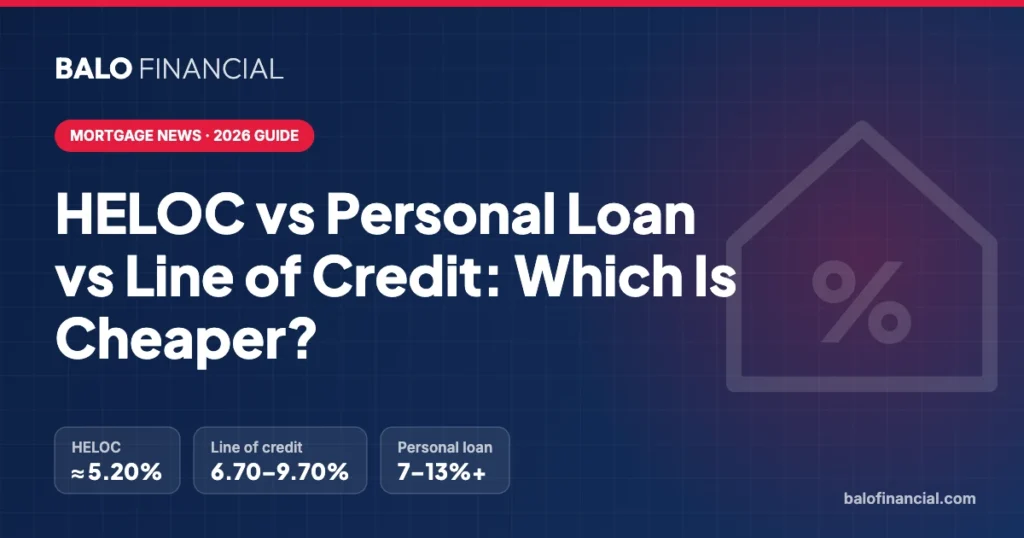
A HELOC is the cheapest way for most Canadian homeowners to borrow, at about 5.20% at the big banks today. An unsecured personal line of credit costs roughly 6.70% to 9.70%, and a personal loan costs about 7% to 13% for good credit (up to 35% with alternative lenders). The HELOC is cheaper because your home secures it. That’s also its biggest risk, and its rate rises every time the Bank of Canada hikes. Choose a HELOC for low cost and flexibility, a personal loan for a fixed payment and a guaranteed payoff date, and a personal line of credit for short-term or emergency money without collateral.
If you own a home in Canada and need to borrow money (for a renovation, to pay off credit cards, to cover a big expense or to invest), you usually end up choosing between three products: a home equity line of credit (HELOC), a personal loan, or a personal line of credit. They can look alike on a bank’s website, but the cost difference can run into thousands of dollars.
This guide compares a HELOC vs personal loan vs line of credit side by side. It covers current 2026 rates, secured vs unsecured borrowing, which banks and lenders offer each product, what it takes to qualify, the fees people forget about, and a real cost example. By the end you’ll know which one is cheapest for your situation, and when the cheapest option isn’t the right one.
Key takeaways
- A HELOC is almost always the cheapest. At the Big Six banks it’s typically prime + 0.50%, which is about 5.20% today.
- Unsecured personal lines of credit usually cost prime + 2% to prime + 5%, or roughly 6.70% to 9.70%+.
- Personal loans from banks and credit unions usually fall around 7% to 13% for good credit. Online and alternative lenders can charge up to the legal cap of 35% APR.
- Secured vs unsecured is the main reason for the price gap. A HELOC uses your home as collateral. Most personal loans and lines of credit use nothing but your credit and income.
- HELOCs and lines of credit are variable. They rose when the Bank of Canada raised its rate on October 28, 2026. Most personal loans have a fixed rate.
- Cheapest isn’t always best. A HELOC puts your home on the line and makes it easy to overspend. A fixed personal loan forces you to pay the debt off on a schedule.
Quick answer: is a HELOC cheaper than a personal loan?
Yes. For most Canadian homeowners, a HELOC is the cheapest way to borrow, followed by an unsecured personal line of credit and then a personal loan. As of November 2026, a standard big-bank HELOC costs about 5.20%. An unsecured line of credit usually costs 6.70% to 9.70%, and a bank personal loan for a borrower with good credit usually costs 7% to 13%.
The reason is collateral. Your home secures a HELOC, so the lender takes much less risk and charges a much lower rate. A personal loan or unsecured line of credit is backed only by your promise to repay.
The trade-off is that a HELOC needs home equity, a property appraisal, legal registration on your title, and a stress test. It also puts your home at risk if you can’t pay. A personal loan can be approved in a day and never touches your house.
What is a HELOC?
A home equity line of credit (HELOC) is a revolving credit line secured by your home. You get a credit limit based on your equity. You can borrow any amount up to that limit, repay it, and borrow again, the same way a credit card works but at a much lower rate.
How a HELOC works in Canada
- Variable rate: HELOCs are priced at the lender’s prime rate plus a margin, such as prime + 0.50%. When prime moves, your rate moves the same day or within days.
- Interest-only payments: Most lenders only require you to pay the interest each month. On a $30,000 balance at 5.20%, that’s about $130 a month. Low payments help with cash flow, but the balance won’t shrink unless you pay extra.
- Revolving: Pay it down and the room comes back. You only pay interest on what you’ve actually used.
- Registered on title: The lender registers a charge on your property, usually a collateral charge.
How much can you borrow with a HELOC?
Federally regulated lenders, including all the big banks, follow OSFI’s Guideline B-20:
- The revolving HELOC portion can’t be more than 65% of your home’s value.
- Your mortgage plus HELOC combined can’t be more than 80% of your home’s value. Any borrowing between 65% and 80% has to be an amortizing mortgage, not revolving credit.
Example: Your home is worth $900,000 and you owe $450,000 on your mortgage. 80% of $900,000 is $720,000. Subtract the $450,000 mortgage and you have up to about $270,000 in total room, subject to the 65% revolving limit and your income qualification.
Readvanceable mortgages (combined plans)
Most big banks sell HELOCs as part of a readvanceable mortgage, also called a combined loan plan. That’s a regular mortgage and a HELOC under one collateral charge. As you pay down the mortgage, your available HELOC room grows. Examples include the RBC Homeline Plan, Scotiabank STEP and the CIBC Home Power Plan. A readvanceable plan is useful, but it can make it harder to switch lenders at renewal, because the collateral charge usually has to be discharged and re-registered.
What is a personal loan?
A personal loan (also called an installment loan or term loan) gives you a lump sum up front, which you repay in fixed monthly payments over a set term, usually 1 to 7 years.
- Usually unsecured: No collateral is needed. Approval depends on your credit score, income and existing debt.
- Usually fixed rate: Your payment stays the same for the whole term, so rate hikes don’t affect you. Some banks and credit unions also offer variable-rate loans.
- Built-in payoff date: Every payment covers principal and interest, so the debt is gone at the end of the term. That forced discipline is the biggest advantage personal loans have over lines of credit.
- Not revolving: Once you repay it, you’d have to apply again to borrow more.
- Typical amounts: Banks usually lend about $1,000 to $50,000 on an unsecured basis.
A secured personal loan also exists. It’s backed by a car, a GIC or investments, and it usually comes with a lower rate than an unsecured loan.
What is a personal line of credit?
A personal line of credit (PLOC) works like a HELOC in that it’s revolving, variable and often interest-only, but it isn’t secured by your home. Most are unsecured, so the rate is higher and the limit is lower, usually around $5,000 to $50,000 at the big banks.
- Unsecured line of credit: Approved on credit and income. It’s typically priced at prime + 2% to prime + 5%, depending on your credit profile.
- Secured line of credit (not a HELOC): Backed by a GIC, savings or an investment portfolio. Its rate is often close to HELOC pricing.
- Student and professional lines of credit: Special programs for students and for professionals such as doctors and dentists. These can sit near prime.
A personal line of credit is a good fit for short-term, uneven needs: an emergency backstop, tuition paid by semester, or smoothing out irregular self-employed income. It’s a poor fit for a large purchase you’ll take years to repay, because you’ll be paying a variable rate on a balance that never has to go down.
Secured vs unsecured: why it changes your rate
This is the most important concept in the HELOC vs personal loan decision.
| Secured borrowing | Unsecured borrowing | |
|---|---|---|
| What backs the loan | An asset: your home, a GIC, investments or a vehicle | Only your credit history and income |
| Examples | HELOC, readvanceable mortgage, secured line of credit, secured car loan | Most personal loans, personal lines of credit, credit cards |
| Lender risk | Low: the lender can recover the money from the asset | Higher: the lender can only sue and report to credit bureaus |
| Typical rate | Close to prime | Prime + 2% and up |
| Borrowing limit | High, depending on the asset value | Lower, usually under $50,000 |
| Approval time | 1 to 4 weeks (appraisal and legal) | Same day to a few days |
| If you can’t pay | You could lose the asset. With a HELOC, that means power of sale or foreclosure on your home | Collections, credit damage, possible legal action. Your home isn’t directly pledged |
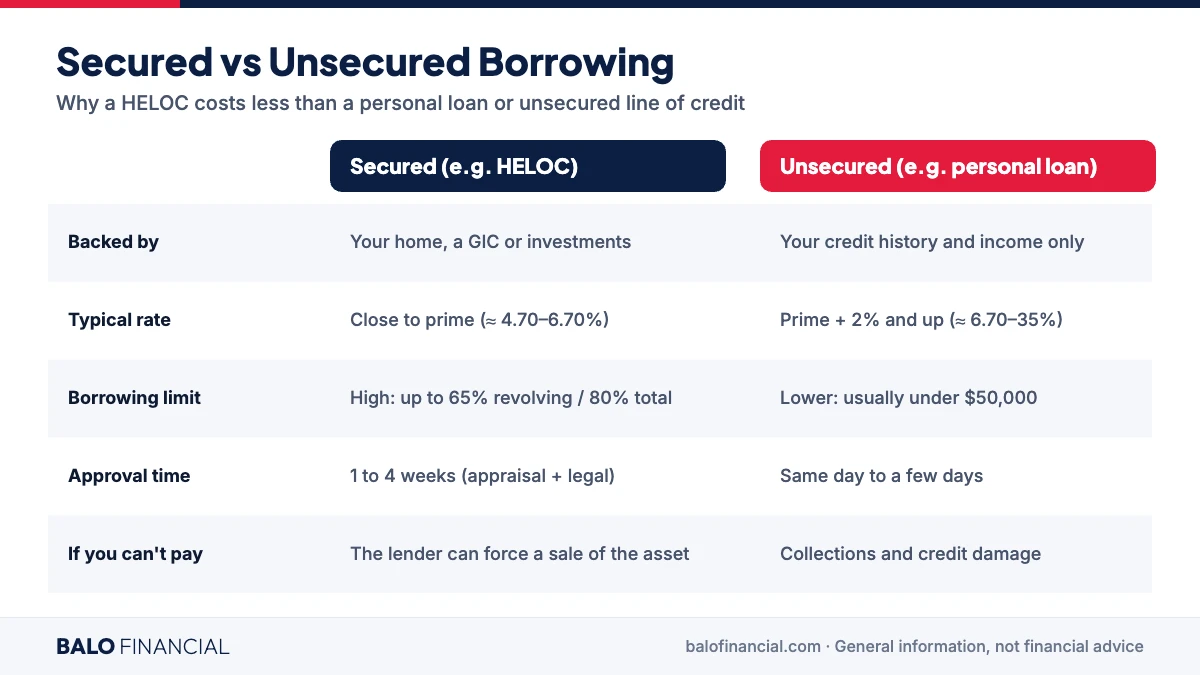
In short, a secured loan is cheaper because you’re taking on more of the risk. That’s a good trade when you’re confident in your repayment plan, and a dangerous one when you aren’t.
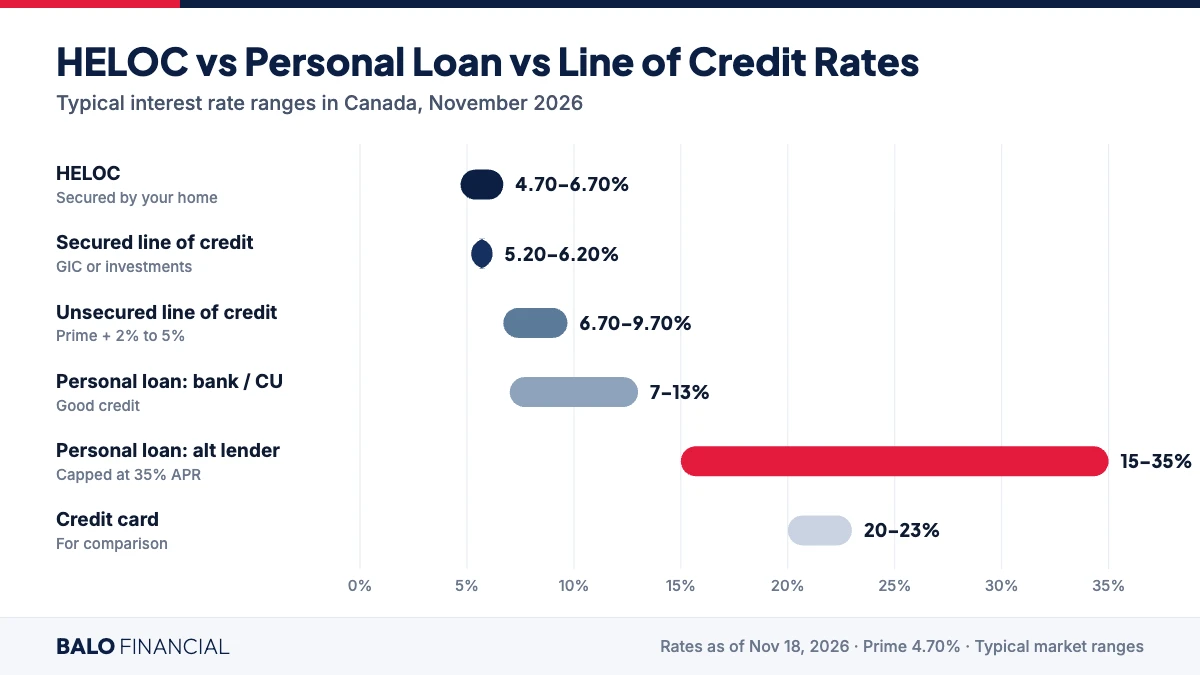
HELOC vs personal loan rates in Canada (2026)
The Bank of Canada raised its policy rate by 0.25% to 2.50% on October 28, 2026, its first increase since 2023. The Big Six banks raised prime from 4.45% to 4.70%, effective October 29. Every prime-based product moved up the same day, including HELOCs, variable mortgages and personal lines of credit. See today’s best mortgage rates for the latest numbers.
| Product | Typical pricing | Approximate rate today | Rate type |
|---|---|---|---|
| HELOC: best-in-market / negotiated | Prime to prime + 0.25% | 4.70% – 4.95% | Variable |
| HELOC: Big Six standard | Prime + 0.50% | 5.20% | Variable |
| HELOC: credit unions and smaller lenders | Prime + 0.50% to prime + 2% | 5.20% – 6.70% | Variable |
| Secured line of credit (GIC or investments) | Prime + 0.50% to prime + 1.50% | 5.20% – 6.20% | Variable |
| Unsecured personal line of credit | Prime + 2% to prime + 5%+ | 6.70% – 9.70%+ | Variable |
| Personal loan: bank or credit union, good credit | Set by credit profile | ~7% – 13% | Usually fixed |
| Personal loan: online or alternative lender | Set by credit profile | ~15% – 35% APR | Fixed |
| Credit card (for comparison) | Standard purchase rate | ~20% – 23% | Fixed |
Rates are typical market ranges as of November 18, 2026, based on a prime rate of 4.70%. Most banks don’t publish personal loan rates, so the rate you’re offered depends on your credit score, income, debt load and relationship with the lender. Since January 1, 2025, Canada’s Criminal Code caps the interest rate on most consumer loans at 35% APR.
Why personal loan rates vary so much
A borrower with a 780 credit score, stable salaried income and low debt might get a bank personal loan in the 7% range. Someone with a 620 score and a recent missed payment might be declined by the banks and offered 25% to 35% by an alternative lender. On a HELOC, the spread between borrowers is much smaller because the house carries most of the risk.
Real cost example: borrowing $30,000 over 5 years
Here’s what $30,000 actually costs when you pay it off over 5 years (60 equal payments) with each option. To keep the comparison fair, the HELOC and line of credit are repaid on the same schedule as the loans, rather than interest-only.
| Option | Rate | Monthly payment | Total interest over 5 years |
|---|---|---|---|
| HELOC (Big Six standard) | 5.20% | $569 | $4,133 |
| Unsecured line of credit (prime + 3%) | 7.70% | $604 | $6,240 |
| Personal loan: credit union | 8.99% | $623 | $7,356 |
| Personal loan: big bank | 9.99% | $637 | $8,236 |
| Credit card (paid on the same schedule) | 20.99% | $811 | $18,686 |
| Personal loan: alternative lender | 24.99% | $880 | $22,822 |
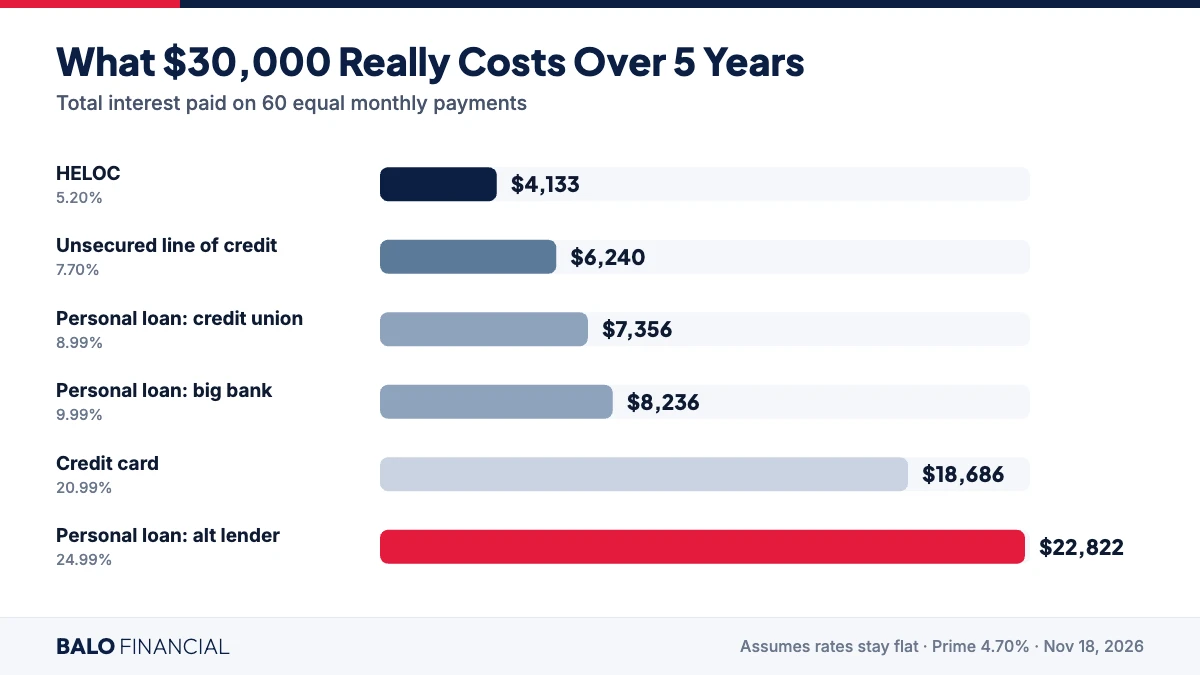
What this shows: On $30,000, the HELOC saves about $4,100 compared with a typical bank personal loan, and more than $18,000 compared with a high-rate alternative lender.
What it doesn’t show:
- HELOC setup costs (appraisal, legal and title fees) can take a bite out of the savings on smaller amounts. Many lenders cover these costs, so ask.
- Rate changes. The HELOC and line of credit figures assume prime stays at 4.70% for five years. If rates rise, they’ll cost more. The personal loan rates are locked.
- Behaviour. If you only make the interest-only minimum on a HELOC ($130 a month here), you’ll still owe the full $30,000 five years from now.
Not sure which one you’d qualify for?
We compare HELOC, refinance and debt consolidation options from 50+ lenders and show you the real numbers side by side. There’s no cost and no obligation.
Get my optionsWhich banks and lenders offer each product?
HELOCs: the Big Six banks
| Bank | HELOC / readvanceable product | Notes |
|---|---|---|
| RBC | RBC Homeline Plan | Readvanceable: combines mortgage segments and a line of credit |
| TD | TD Home Equity FlexLine | Can be paired with a TD mortgage; portions can be locked in at a fixed rate |
| Scotiabank | Scotia Total Equity Plan (STEP) | Umbrella plan holding a mortgage, ScotiaLine and other credit |
| BMO | BMO Homeowner ReadiLine | Readvanceable line linked to a BMO mortgage |
| CIBC | CIBC Home Power Plan | Combines a mortgage and a line of credit under one limit |
| National Bank | All-In-One account | Combines banking and a home equity line in one account |
HELOCs: other lenders
- Digital and direct banks: Tangerine offers a Home Equity Line of Credit, and Manulife Bank offers Manulife One, an all-in-one account.
- Credit unions: Meridian, Alterna, Desjardins (caisses populaires) and others. Credit unions are provincially regulated, so some can offer revolving HELOCs above the 65% limit that federally regulated banks follow.
- Broker-channel and alternative lenders: Some lenders that work through mortgage brokers offer HELOCs or second-position equity lines, which helps self-employed borrowers or anyone a bank turned down.
- Private lenders: Short-term private equity lines and second mortgages exist for difficult files. They cost much more, with higher rates and lender fees, and are meant as a short-term bridge.
Personal loans
- Big Six banks (RBC, TD, BMO, Scotiabank, CIBC, National Bank): best for existing clients with good credit. Rates are usually given at application rather than published.
- Credit unions: often match or beat bank pricing for members, and can be more flexible with unusual income.
- Online and alternative lenders (such as Fairstone, easyfinancial, Spring Financial and Mogo) and loan marketplaces (such as LoanConnect and Loans Canada): approve weaker credit quickly, at much higher rates.
Personal lines of credit
- Big Six banks: for example, the RBC Royal Credit Line, TD Personal Line of Credit, ScotiaLine Personal Line of Credit, BMO Personal Line of Credit and CIBC Personal Line of Credit.
- Digital banks and credit unions: Tangerine, Desjardins, Meridian and others, often with clearly published prime-plus pricing.
- Fintech credit lines: smaller-limit lines from online lenders, priced closer to personal loan rates.
How to qualify for each
| Requirement | HELOC | Personal loan | Unsecured line of credit |
|---|---|---|---|
| Home equity | Required: at least 20% equity, since total borrowing is capped at 80% loan-to-value | Not required | Not required |
| Credit score | Generally 650+ at banks; 680+ for the best pricing | Generally 660–680+ at banks; lower with alternative lenders | Generally 680+ for good pricing |
| Stress test | Yes: banks qualify you at the higher of your rate + 2% or 5.25% | No mortgage stress test | No mortgage stress test |
| Income documents | Full: pay stubs, employment letter, T4s or NOAs; 2 years of returns if self-employed | Lighter: often pay stubs and bank statements | Lighter, similar to a personal loan |
| Appraisal | Usually required | No | No |
| Lawyer or title work | Yes: a charge is registered on title | No | No |
| Time to funds | About 1–4 weeks | Same day to about a week | A few days |
Debt ratios matter for all three. Lenders compare your monthly debt payments with your gross income. For an insured mortgage, CMHC caps total debt service at 44% of gross income. Lenders set their own limits for uninsured borrowing such as HELOCs. Unused HELOC limits often count against you too, because many lenders assume a payment on the full limit even if your balance is $0.
Fees and hidden costs
HELOC costs
- Appraisal: often a few hundred dollars. Some lenders waive it or use an automated valuation.
- Legal and title registration: often several hundred to over a thousand dollars. Many banks run promotions that cover these costs.
- Discharge and switching costs: if your HELOC is part of a collateral charge, moving your mortgage to another lender usually means paying to discharge it and re-register a new one.
- Annual or account fees: uncommon at the big banks, but check, especially with all-in-one accounts.
Personal loan costs
- Origination or admin fees: rare at banks, more common with online lenders. These fees count toward the APR.
- Optional loan insurance: often offered at signing. It adds a real cost, so read the terms before you say yes.
- Prepayment penalties: most Canadian personal loans let you prepay without a penalty, but confirm it in your agreement.
Personal line of credit costs
- Usually no setup cost. Watch for annual fees on some products and overlimit fees.
Tip: Compare loans by APR, not just the interest rate. APR includes fees. A “9.99%” loan with a $500 admin fee can cost more than a 10.49% loan with no fees.
Pros and cons side by side
HELOC
Pros: lowest rate; high limits; borrow only what you need; interest-only payments for flexibility; re-borrow without reapplying; for funds borrowed to earn investment income, interest may be tax-deductible (ask your accountant).
Cons: secured by your home; variable rate rises with every Bank of Canada hike; setup time and costs; stress test needed; easy to stay in debt indefinitely; can complicate switching lenders at renewal; the bank can reduce or freeze your limit.
Personal loan
Pros: fixed payment and a fixed payoff date; usually a fixed rate that’s protected from hikes; no home equity needed; fast approval; your house isn’t pledged.
Cons: higher rate than a HELOC; lower limits; lump sum only, so you pay interest on all of it from day one; you need a new application to borrow again; high-rate lenders can be very expensive.
Personal line of credit
Pros: flexible and revolving; you pay interest only on what you use; no collateral; good as an emergency backstop; usually cheaper than a credit card.
Cons: variable rate; higher cost than a HELOC; no forced payoff; lower limits; the lender can lower your limit.
Which should you choose? 6 common scenarios
1. Large home renovation ($40,000+)
Usually a HELOC (more on financing a home renovation). Contractors bill in stages, so drawing only what you need saves interest, and the low rate makes a big difference on a large amount. Set yourself a firm repayment plan, or ask about locking the balance into a fixed-rate term once the work is done.
2. Consolidating credit card debt
A HELOC or a refinance gives the lowest rate. A personal loan is safer if you might run the cards up again. (Run the numbers with our guide to debt consolidation math.) Moving 21% debt to about 5% is a huge saving, but only if the cards stay paid off. If you’re worried about that, a fixed personal loan with a hard end date is the more disciplined choice.
3. Emergency fund or “just in case” money
An unused HELOC or personal line of credit. Opening one costs little or nothing if you don’t draw on it. Open it while your income and credit are strong, not after a job loss, when approval gets harder.
4. A car or a one-time purchase under $20,000
A personal loan or dealer financing. HELOC setup costs and paperwork may not be worth it for a smaller amount, and a fixed term makes sure the purchase gets paid off.
5. Investing or a property down payment
Usually a HELOC, because of the rate and the potential for interest deductibility on borrowing used to earn investment income. Using a HELOC toward a down payment on another property is a common strategy, but the borrowed funds count in your debt ratios and some lenders have specific rules. Get advice before you commit.
6. Lower credit score or recent credit issues
Look at home equity first (see our options for borrowers with credit issues). If you own a home with good equity, a broker-channel or alternative equity product is usually far cheaper than a 25% to 35% unsecured loan, even with lender fees. Use high-rate personal loans only as a short-term last resort, with a clear plan to refinance.
Risks to know before you borrow
- Rising rates: Every 0.25% increase in prime adds about $125 a year in interest per $50,000 owed on a HELOC or line of credit. The Bank of Canada’s next decision is December 9, 2026, and some bank economists expect another increase in early 2027.
- Your home is on the line: Missing HELOC payments can ultimately lead to power of sale or foreclosure.
- Falling home values: If prices drop, a lender can reduce or freeze your HELOC limit, often when you need it most.
- The “forever debt” trap: With interest-only minimums, many Canadians carry HELOC balances for a decade or more. Treat a HELOC like a loan and give it a payoff date.
- Debt ratios: A large HELOC limit, even unused, can reduce how much you qualify for on your next mortgage.
Alternatives: refinance, second mortgage and more
- Cash-out refinance: Increase your mortgage up to 80% of your home’s value and take the difference in cash. You can lock a fixed rate, and the debt is built into an amortization. It’s often the best choice for a large, one-time need, but watch for prepayment penalties if you break your current mortgage mid-term.
- Blend-and-extend: Some lenders will add new funds to your existing mortgage at a blended rate without a full break penalty.
- Second mortgage: A separate loan behind your first mortgage, used when refinancing the first would trigger a large penalty. It costs more than a HELOC but can be cheaper than breaking your mortgage.
- Secured line of credit against investments or a GIC: HELOC-level pricing without touching your home.
- 0% promotional financing: Fine for a planned purchase, as long as you pay it off before the promotion ends.
The bottom line
A HELOC is the cheapest way for most Canadian homeowners to borrow: about 5.20% at the big banks today, compared with roughly 6.70% to 9.70% for an unsecured line of credit and 7% to 13% or more for a personal loan. It’s cheaper because it’s secured by your home, which is also why it needs a plan. If you want low cost and flexibility, and you’ll stay disciplined, choose a HELOC. If you want a fixed payment, a guaranteed payoff date and no risk to your home, choose a personal loan. For short-term or emergency borrowing without collateral, choose a personal line of credit.
Frequently asked questions
Is a HELOC cheaper than a personal loan?
Yes, in most cases. A big-bank HELOC is typically prime + 0.50%, about 5.20% as of November 2026. A personal loan from a bank or credit union usually costs 7% to 13% for good credit, and online lenders can charge up to 35% APR. The HELOC is cheaper because it’s secured by your home.
Is a personal line of credit secured or unsecured?
Most personal lines of credit are unsecured, so no collateral is needed and approval depends on your credit and income. Secured personal lines of credit also exist, backed by a GIC, savings or investments, and they carry lower rates. A HELOC is a line of credit secured specifically by your home.
How much can I borrow with a HELOC in Canada?
At federally regulated lenders such as the big banks, the revolving HELOC portion can be up to 65% of your home’s value, and your mortgage plus HELOC combined can be up to 80%. Your actual limit also depends on your income, credit and the lender’s stress test.
Do HELOC rates go up when the Bank of Canada raises rates?
Yes. HELOCs are priced at prime plus a margin, and banks move prime with the Bank of Canada’s policy rate. When the Bank of Canada raised its rate to 2.50% on October 28, 2026, the big banks raised prime to 4.70% the next day, and HELOC rates rose by the same 0.25%.
Can I get a HELOC with bad credit?
It’s harder at the big banks, which generally want scores around 650 or higher. Some credit unions, broker-channel lenders and private lenders offer home equity lines or second mortgages to borrowers with weaker credit, at higher rates. Even so, they’re often cheaper than high-rate unsecured loans.
What credit score do I need for a personal loan in Canada?
Banks generally look for a score of about 660 to 680 or higher for their best personal loan rates. Alternative lenders approve lower scores but charge much higher interest, up to the 35% APR legal limit.
Is it smart to use a HELOC to consolidate debt?
It can save a lot of interest, since moving credit card debt at about 21% to a HELOC at about 5% cuts the cost sharply. It only works if you stop adding new card debt and pay the HELOC down on a schedule. If you’re not sure you will, a fixed-term personal loan or a refinance is the safer choice.
Which Canadian banks offer HELOCs?
All of the Big Six banks offer HELOCs, usually as part of a readvanceable mortgage: the RBC Homeline Plan, TD Home Equity FlexLine, Scotiabank STEP, BMO Homeowner ReadiLine, CIBC Home Power Plan and National Bank All-In-One. Tangerine, Manulife Bank, many credit unions and some broker-channel lenders offer them too.
Related articles
Find out how much equity you can unlock
Tell us what you need the money for. We’ll compare HELOCs, refinances and debt consolidation options from 50+ lenders and show you the lowest-cost option you qualify for.
Start my free comparisonDisclaimer: This article is for general information only and is not financial, legal or tax advice. Rates are approximate market ranges as of November 18, 2026, and change often. Your rate and approval depend on your personal credit, income, property and lender criteria. Speak with a licensed mortgage professional, and a tax professional about interest deductibility, before you borrow.
Sources: Bank of Canada, Oct. 28, 2026 rate announcement · OSFI Guideline B-20 clarification on combined loan plans